

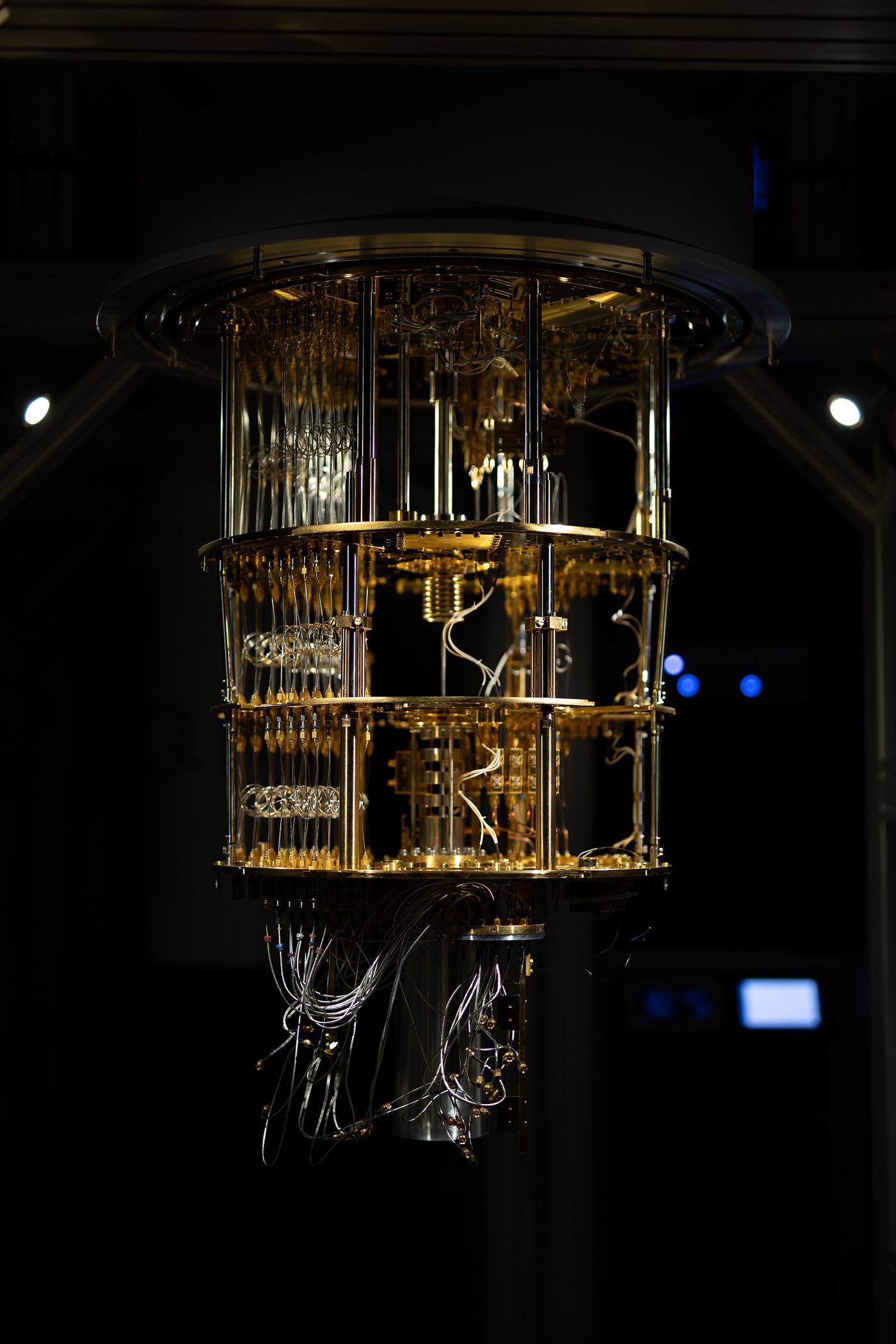
Quantum computers have long promised to solve certain problems that would take classical machines longer than the age of the universe — while stumbling on a basic flaw: their building blocks are extraordinarily fragile. Qubits lose their delicate quantum states at the slightest disturbance, introducing errors faster than early machines could fix them. Recent demonstrations of improved quantum error correction, in which many physical qubits cooperate to protect one logical qubit, suggest that flaw is finally yielding to engineering.
Error Correction Changes the Question
The milestone is not a bigger machine but a more trustworthy one. In the new results, adding more qubits to an error-correcting code reduced the error rate instead of multiplying failure points — the threshold behaviour theorists predicted decades ago. Coverage in Nature explains why that inversion matters: it converts scaling from a gamble into a roadmap, where sufficiently large machines should be able to run long, useful calculations without their answers dissolving into noise.
For readers of our technology pages, the practical translation is timing. Drug discovery, materials design, fertiliser chemistry and complex logistics are the canonical early applications, because they involve quantum-scale interactions that classical computers approximate crudely. A fault-tolerant machine could simulate a promising molecule directly, shortening research cycles that currently consume years of laboratory trial and error.
Competition, Caution and Cryptography
Multiple approaches are racing toward the same goal — superconducting circuits, trapped ions, neutral atoms and photonic systems — each with distinct strengths. Governments fund the field partly for science and partly for security: a sufficiently powerful quantum computer could break today’s common encryption, which is why standards bodies have already approved post-quantum cryptography for organisations to adopt before such machines exist, as guidance from security agencies summarised by Reuters makes clear.
Researchers are careful to separate milestone from magic. Useful, fault-tolerant quantum computing still requires far larger machines, better materials and enormous classical support infrastructure. Timelines quoted in headlines should be treated sceptically. But the direction of travel has changed: the field’s central question is shifting from whether error correction can work to how fast it can be scaled. In a technology defined by decades of patient physics, that is what a turning point looks like.
Investment patterns reflect the shift from speculation to engineering. Funding that once chased headline qubit counts now rewards demonstrated error rates, manufacturing repeatability and the classical software needed to run real algorithms. Universities, meanwhile, are expanding interdisciplinary programmes because the field needs cryogenics engineers and control-systems specialists as urgently as it needs theorists. The talent pipeline may prove the true speed limit: error correction at scale is as much a workforce challenge as a physics one. Countries treating quantum skills as strategic infrastructure — funding chairs, laboratories and startups together — are positioning themselves for an industry whose centre of gravity is still genuinely up for grabs.
For now, the milestone belongs in the steady-progress column: unglamorous, technical and exactly how durable technologies have always been built over time.
