

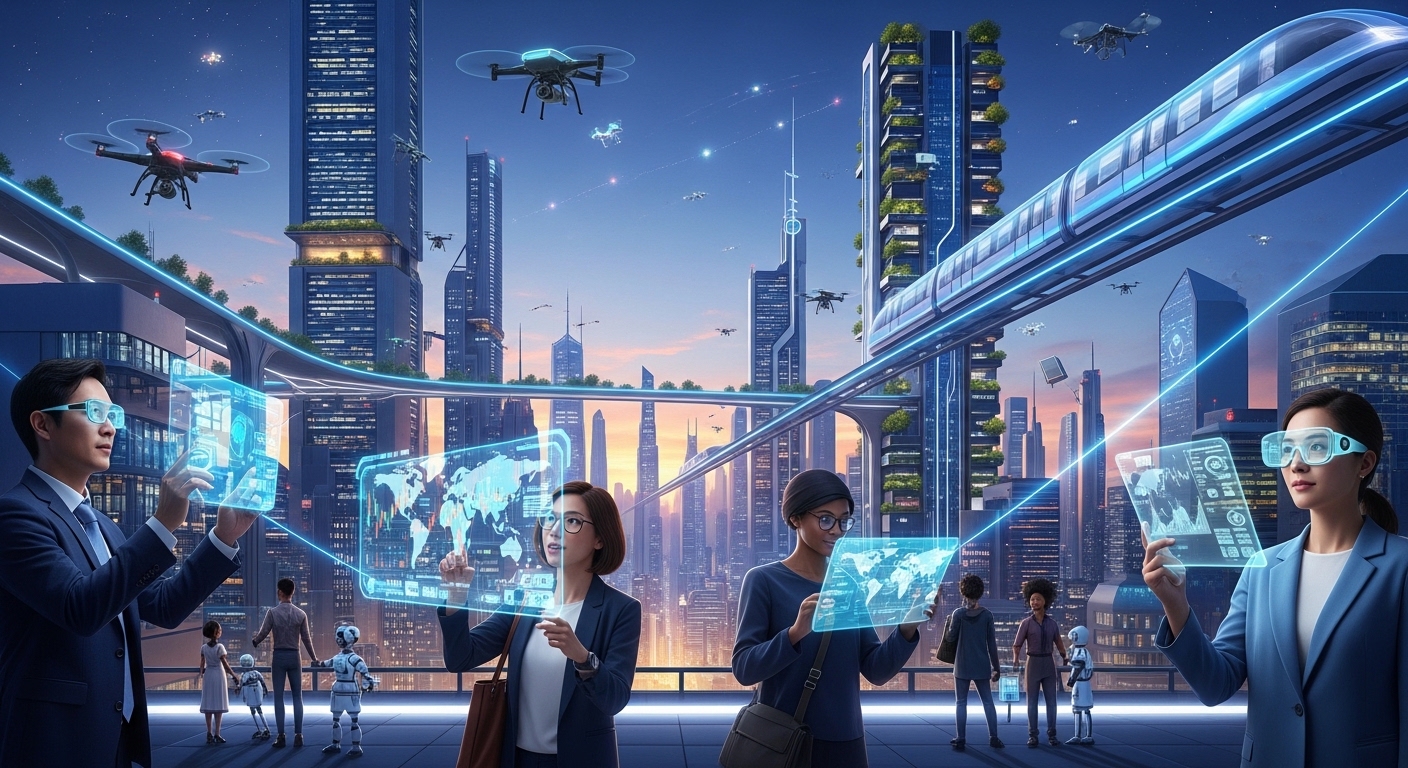
Here are the latest innovations in technology shaping the future, based on current global trends in AI, robotics, quantum computing, and digital transformation.
Artificial Intelligence Everywhere
Agentic AI Systems
AI is evolving from simple assistants into autonomous “agentic” systems that can plan, decide, and act independently. These systems are already being used in business operations, logistics, and personal productivity tools, transforming how work is done across industries.
Generative AI Expansion
Generative AI is now creating text, images, video, music, and software code at scale. It is revolutionizing content creation, marketing, and entertainment by reducing production time and increasing creativity.
AI In Real World Applications
AI is no longer limited to digital tasks—it is powering robots, vehicles, smart homes, and industrial systems. This shift is known as “physical AI,” where machines interact directly with real-world environments.
AI Powered Decision Systems
Businesses and governments are using AI for predictive analytics, risk management, and strategic decision-making, improving speed and accuracy in complex operations.
Responsible And Ethical AI
With AI expansion, governments and companies are focusing on transparency, fairness, and regulation to ensure safe and responsible use of intelligent systems.
Robotics and Autonomous Systems
Humanoid Robot Development
Humanoid robots are being developed for factories, warehouses, healthcare, and even household assistance, making automation more human-like and adaptable.
Industrial Automation Growth
Factories are increasingly using robotic systems for manufacturing, improving speed, precision, and cost efficiency in global production.
Service Robots Expansion
Service robots are entering hotels, hospitals, and retail environments, handling tasks like delivery, cleaning, and customer support.
Autonomous Vehicles Progress
Self-driving cars and drones are advancing with better sensors, AI navigation, and safety systems, aiming to reduce human error in transportation.
Human Robot Collaboration
Modern robotics is focusing on collaboration where humans and robots work together safely in shared environments.
Quantum Computing Breakthroughs
Quantum Processing Power
Quantum computers use qubits instead of traditional bits, allowing them to solve extremely complex problems much faster than classical computers.
Cryptography Revolution
Quantum computing is expected to break current encryption systems, pushing the development of new quantum-safe cybersecurity methods.
Drug Discovery Acceleration
Quantum simulations help researchers model molecules more accurately, speeding up pharmaceutical research and medical innovation.
Financial Modeling Innovation
Banks and financial firms are exploring quantum computing for risk analysis, portfolio optimization, and market prediction.
Hybrid Classical Quantum Systems
Future computing systems will combine classical and quantum computing for maximum performance and efficiency.
Connectivity and Next-Gen Networks
6G Network Development
6G technology is being developed to enable ultra-fast internet, holographic communication, and real-time AI systems.
Edge Computing Growth
Data is increasingly processed closer to devices instead of centralized servers, improving speed and reducing latency.
Satellite Internet Expansion
Global satellite networks are improving internet access in remote and underserved regions worldwide.
Smart Network Optimization
AI-powered networks automatically manage traffic, speed, and performance for better digital connectivity.
Cloud Infrastructure Evolution
Cloud platforms are becoming more powerful, scalable, and integrated with AI tools for global business use.
Immersive and Spatial Technologies
Virtual Reality Expansion
VR is creating immersive environments for gaming, training, education, and virtual meetings with realistic simulations.
Augmented Reality Integration
AR overlays digital information onto real-world environments, enhancing navigation, shopping, and learning experiences.
Spatial Computing Growth
Spatial computing blends physical and digital worlds using sensors, AI, and 3D environments for interactive experiences.
Digital Twin Technology
Industries are building virtual replicas of real systems to simulate performance and improve decision-making.
Metaverse Development
Virtual worlds are evolving into social, business, and entertainment ecosystems where users interact digitally.
Biotechnology and Health Innovation
AI Driven Healthcare
AI is improving disease diagnosis, treatment planning, and patient monitoring with faster and more accurate results.
Genetic Engineering Advances
Gene editing technologies are enabling new treatments for diseases and personalized medical solutions.
Digital Health Monitoring
Wearable devices track real-time health data, helping detect medical issues early.
Personalized Medicine
Treatments are being tailored based on individual genetics and lifestyle data.
Bioinformatics Growth
Data-driven biology is accelerating research in medicine, genetics, and disease prevention.
Sustainable and Green Technology
Renewable Energy Systems
Solar, wind, and clean energy technologies are expanding rapidly to reduce dependence on fossil fuels.
Carbon Capture Technology
New systems are being developed to capture and reduce carbon emissions from industries.
Smart Energy Grids
AI-powered energy grids optimize electricity distribution and reduce waste.
Electric Transportation Growth
Electric vehicles and smart mobility systems are transforming transportation worldwide.
Climate Innovation Tech
New technologies are focused on monitoring, predicting, and combating climate change effects.
Conclusion
Latest technology innovations show a clear shift toward intelligent, automated, and interconnected systems. AI, robotics, quantum computing, and sustainable technologies are driving the biggest transformation in human history. As these innovations continue to evolve, they will redefine industries, improve daily life, and shape a smarter, more efficient, and highly connected global future.